
Makita Cordless Track Saw
Accuracy and Power In a Compact Form
TOP PICK: MAKITA SP6000J
IN THIS GUIDE:
As of 2026, the track saw market is defined by a shift toward safety and increased capacity. We are seeing a move away from the standard 55mm cut depth that dominated the market for years. Newer models, like the Festool TS 60, are pushing capacities to 60mm and 62mm. This seemingly small increase is significant because it allows the saw to cut through thicker dimensional lumber and fire doors that older models struggled with.
Furthermore, active safety technology is becoming a standard expectation rather than a luxury. Electronic kickback stops, which sense the sudden upward movement of the tool during a bind and disengage the motor, are becoming a key differentiator. In 2026, woodworkers are increasingly prioritizing these active safety features over raw power alone.
Buying into a battery platform is also a major driver. With manufacturers expanding their high-output battery lines (like Milwaukee’s High Output and DeWalt’s FlexVolt), the runtime anxiety that once plagued cordless saws is largely a thing of the past. Woodworkers can now expect to rip dozens of sheets of plywood on a single charge.
› PROFESSIONAL SAW: FESTOOL TS55
› CORDLESS PICK: MAKITA SP6000J
› PROFESSIONAL CORDLESS: FESTOOL TSC 55
› BUDGET OPTION: WEN CT1065
Page Contents
Top Track Saw Manufacturers
While many tool brands now offer a track saw, a few manufacturers stand out for their engineering, ecosystem, and reliability. Understanding the pedigree of these brands can help frame your purchasing decision.
Festool
Widely credited with popularizing the modern plunge-cut track saw, Festool remains the gold standard. Their tools are designed as a complete system, integrating seamlessly with dust extractors, guide rails, and multifunction tables (MFT). They are known for premium pricing but offer unmatched precision, resale value, and longevity.
Makita
Makita is a favorite among intermediate woodworkers and professionals alike. They offer a balance of professional-grade performance and accessibility. Their track saws are often cited as the best value proposition, delivering accuracy that rivals premium brands at a more moderate price point.
DeWalt
Known for rugged durability, DeWalt approaches the track saw with a unique design philosophy. Their saws often feature a different plunge mechanism and are heavily integrated into the FlexVolt battery ecosystem, making them a top choice for those already invested in DeWalt’s cordless platform.
Milwaukee
A relative newcomer to the track saw market compared to Festool, Milwaukee has quickly made up ground. Their M18 FUEL track saw is designed for power users who demand cordless convenience without sacrificing the torque required for cutting thick hardwoods.
Bosch
Bosch tools are celebrated for precision engineering. Their track saws are highly regarded for their similarities to ultra-premium European brands like Mafell, offering exceptional build quality and a track system that connects easily for long rips.
Top Corded Track Saws
For woodworkers who primarily work in a shop environment where power outlets are plentiful, corded saws offer consistent power and generally lower weight since there is no heavy battery pack attached.
Makita SP6000J
The Makita SP6000J has been a staple in the woodworking community for years. It features a 12-amp motor and a variable speed dial (2,000 – 5,200 RPM), allowing users to optimize the blade speed for different materials. It is highly praised for its smooth plunge action and reliable track compatibility. It includes a specialized lever that locks the saw to the rail when performing bevel cuts, preventing the tool from tipping over—a common issue with other designs.
- Amperage: 12 AMPS
- RPM: 2,000 – 5,200 (Variable Speed)
- Max Cut Capacity (90°): 2-3/16″
- Max Cut Capacity (45°): 1-9/16″
- Bevel Capability: -1° to 48°
- Weight: 9.7 lbs
- Standout Feature: Electronic speed control maintains constant speed under load for smooth cutting.
Festool TS 60 KEB
The TS 60 KEB represents the current pinnacle of corded track saw technology. It replaces earlier models as the new benchmark for safety and capability. Its standout feature is the cutting depth of 62mm (2-7/16 inches), which allows for cutting standard 2x material even when beveled to 45 degrees. It also features Festool’s Kickback Stop technology, which stops the blade in a fraction of a second if it binds, protecting both the user and the workpiece.
- Power: 1500 Watts
- RPM: 3,000 – 6,800
- Max Cut Capacity (90°): 57mm (2-1/4″)
- Max Cut Capacity (45°): 40mm (1-9/16″)
- Max Cut Depth (off rail): 62mm (2-7/16″)
- Weight: 4.8 kg (10.58 lbs)
- Standout Feature: The Kickback Stop reduces the risk of injury caused by a kickback during sawing or plunging.
Top Cordless Track Saws
Cordless technology has advanced to the point where battery-powered saws can match, and often exceed, the performance of their corded counterparts. These are ideal for job sites or shops where managing cables is a hassle.
Milwaukee M18 FUEL (2831-21)
This saw is built around the POWERSTATE™ Brushless Motor, which delivers 5,600 RPM. Milwaukee focused heavily on dust collection with this model, incorporating an enclosed guard and a dust bag that claims to collect over 90% of dust even without a vacuum attached. It is a robust option for those who need to rip thick hardwoods, as the electronics are designed to maintain speed under load.
- Voltage: 18V
- RPM: 2,500 – 5,600
- Blade Diameter: 6-1/2″
- Bevel Stops: 0, 22.5, 45, and 48 degrees
- Weight: 9.13 lbs (Bare tool)
- Standout Feature: 90%+ dust collection efficiency and a retractable riving knife that stays in position even during plunge cuts.
DeWalt FlexVolt DCS520
DeWalt utilizes a unique linkage mechanism for plunging rather than the standard pivot point found on most other saws. This keeps the user’s hand in a consistent position relative to the tool throughout the plunge. Running on the 60V FlexVolt platform, it offers immense power. It also features a zero-clearance cutting system and an anti-kickback mechanism for safety.
- Voltage: 60V MAX
- RPM: 1,750 – 4,200
- Max Cut Depth (90° on rail): 2-1/8″ (54mm)
- Max Cut Depth (45° on rail): 1-5/8″ (41mm)
- Weight: 12.5 lbs
- Standout Feature: The continuous anti-kickback mechanism and riving knife prevent kickback when engaged, and the parallel plunge allows for optimal ergonomics.
Bosch PROFACTOR GKT18V-20GCL
Bosch combines their BITURBO Brushless technology with their CORE18V batteries to create a saw that rivals corded performance. A notable feature is the “ECO mode,” which can extend battery runtime by up to 30% for lighter cutting tasks. It is designed for superior mobility and has a very tight clearance, allowing for cuts as close as 0.4 inches from a wall.
Key Buying Criteria
1. The Rail System Compatibility
The saw is only half the equation; the rail (or track) is the other half. Festool and Makita use a very similar rail profile. This means if you buy a Makita saw, you can usually use Festool clamps, squares, and accessories. DeWalt uses a proprietary rail. If you plan to expand your kit with aftermarket accessories like “rail squares” or parallel guides (which allow for repeatable cuts), the Festool/Makita style rail has unparalleled aftermarket support.
2. Riving Knives and Safety
A riving knife is a piece of metal that sits behind the blade. As you cut through wood, internal tension can cause the wood to close up (pinch) behind the blade. If this happens without a riving knife, the blade catches the wood and throws the saw backward—this is kickback.
- Festool: All models utilize either a riving knife or the electronic KickbackStop.
- DeWalt: Includes a riving knife.
- Makita: Does not have a traditional riving knife, relying instead on electronic controls to manage the motor. For beginners, a physical riving knife or active stop system offers superior peace of mind.
3. Depth of Cut
Consider what you build.
- Sheet Goods Only: If you only cut 3/4″ plywood or MDF, any saw on this list (TS 55, Makita, DeWalt) is perfect.
- Thick Lumber: If you plan to make tabletops out of 8/4 (2-inch thick) lumber, the standard saws will struggle. You will need the Festool TS 60 K (which clears 2 inches on the rail) or the powerful TS 75.
4. Dust Collection
One of the primary benefits of a track saw is the enclosed blade guard, which allows for incredible dust capture. If you are working in a basement shop or a client’s finished home, this matters. Festool is widely regarded as the leader in dust extraction efficiency, capturing nearly all sawdust when paired with a proper vacuum. Makita and DeWalt are capable, but Festool’s enclosed housing design usually gives it the edge.
Why Choose a Track Saw Over a Table Saw?
Before diving into specific models, it is helpful to understand why you might choose a track saw, especially if you already own a table saw.
- Safety: Moving the tool over stationary wood is generally safer than pushing a heavy, awkward sheet of wood over a spinning blade.
- Space Efficiency: A table saw requires massive infeed and outfeed clearance. A track saw requires only enough floor space to lay down the foam insulation and the plywood sheet.
- Cut Quality: Track saws feature splinter guards on the rail and the saw itself. This sandwiches the wood fibers, resulting in virtually tear-out-free cuts on both sides of the blade, even with delicate veneers.
- Portability: You can take a track saw to the lumber yard or a job site. You cannot easily transport a cabinet saw.
The Gold Standard: Festool Track Saw Lineup
Festool invented the modern track saw system, and they continue to dominate the category with the widest range of options. Their system is known for dust extraction efficiency, build quality, and a vast ecosystem of accessories. Here is a detailed breakdown of their primary corded models.
Festool TS 55 FEQ: The All-Rounder

For most woodworkers, the TS 55 FEQ is the entry point into the Festool ecosystem. It is the modern iteration of the saw that popularized the track saw category. It is lightweight, precise, and capable of handling 90% of the cuts a hobbyist or cabinet maker will encounter.
- Blade Diameter: 6-1/4″ (160 mm)
- Cutting Depth at 90°: 2-1/8” (55 mm)
- Cutting Depth at 45°: 1-11/16” (43 mm)
- Weight: 10.58 lbs
- Bevel Range: -1° to 47°
Key Features:
The TS 55 FEQ features a flat housing that allows you to cut as close as 1/2 inch to a wall, making it excellent for flooring installation. It includes a spring-loaded riving knife (a safety wedge behind the blade) that descends before the blade cuts, preventing the wood from pinching the blade and causing kickback.
Pros:
- Proven design with decades of reliability.
- Excellent dust extraction when paired with a HEPA vacuum.
- Lightweight enough for all-day use.
- Compatible with the full range of Festool guide rails.
Cons:
- Cutting depth is limited to standard sheet goods and 1x material; it struggles with thicker hardwoods.
- Lacks the advanced safety sensors found in newer models.
You can buy the Festool FEQ on Amazon
Festool TS 60 K: The New Standard
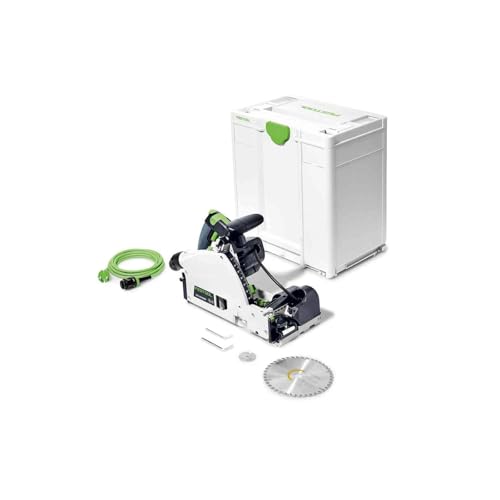
The TS 60 K is a significant evolution in the Festool lineup. While it looks similar to the TS 55, it features a new motor and a critical safety innovation known as KickbackStop.
- Blade Diameter: 6-5/8″ (168 mm)
- Cutting Depth at 90°: 2-7/16” (62 mm)
- Cutting Depth at 45°: 1-11/16” (with guide rail)
- Weight: Similar profile to TS 55
- Bevel Range: -1° to 47°
Key Features:
The standout feature here is the KickbackStop. If the saw senses a kickback event (where the saw jumps backward out of the cut), the motor stops instantly, and the saw blade locks in place. This protects both the user and the workpiece. Unlike other systems that destroy a brake cartridge, this system can be reset manually with zero cost.
Additionally, the cut depth has increased to 62mm. This may seem minor, but it allows the saw to cut through 2-inch material even while on the guide rail, something the TS 55 cannot do.
Pros:
- KickbackStop technology significantly enhances user safety.
- Increased depth of cut allows for cross-cutting 2x lumber on the rail.
- Brushless EC-TEC motor is robust and maintenance-free.
- Can connect to the FSK cross-cutting guide rails (previously reserved for carpentry saws).
Cons:
- Uses a unique blade size (168mm), meaning you cannot swap blades with older TS 55 models.
- Higher price point than the TS 55.
You can buy the Festool TS 60 K on Amazon
Festool TS 75 EBQ: The Heavy Hitter
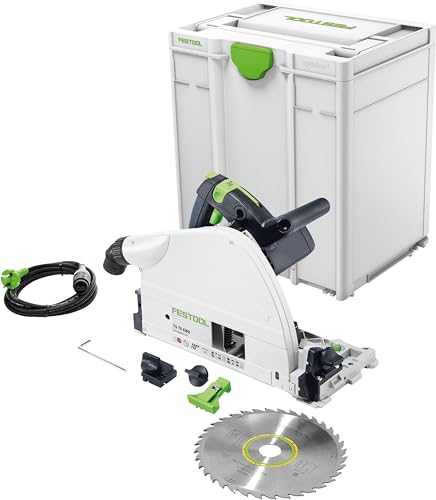
If you regularly process thick slabs, rough lumber, or stack-cut multiple sheets of plywood at once, the TS 75 EBQ is the necessary tool. It is larger, heavier, and more powerful than its siblings.
- Blade Diameter: 8-1/4″ (210 mm)
- Cutting Depth at 90°: 2-15/16” (75 mm)
- Cutting Depth at 45°: 2-1/8” (55 mm)
- Weight: 13.6 lbs
- Power: 1600 Watts (13 Amps)
Key Features:
The TS 75 uses a slip clutch to prevent motor burnout if the blade binds in thick, wet lumber. It also features a “FastFix” system for easier blade changes. The sheer depth of the cut allows you to rip nearly 3-inch thick maple or oak without bogging down.
Pros:
- Massive cutting capacity for a track saw.
- High torque motor handles hardwoods easily.
- Exceptional stability due to the heavier weight.
Cons:
- Significantly heavier and more unwieldy for quick cuts.
- Overkill for standard 3/4″ plywood processing.
- Cost prohibitive for casual hobbyists.
You can buy the Festool TS 75 EBQ on Amazon
Festool TSV 60: The Specialist
For woodworkers working exclusively with melamine, pre-finished plywood, or high-gloss veneers, chip-out is the enemy. The TSV 60 solves this by integrating a scoring blade, a feature usually found only on massive industrial panel saws.
- Blade Diameter: 6-5/8″ (Main) / 1-27/32″ (Scoring)
- Cutting Depth at 90°: 2-3/8” (60 mm)
- Key Tech: Diamond Scoring Blade
Key Features:
The TSV 60 has a small diamond blade located in front of the main blade. This scorer cuts the top layer of the veneer just slightly wider than the main blade, ensuring a perfect, factory-edge finish on the top surface. Like the TS 60 K, it also includes the KickbackStop.
Pros:
- Produces arguably the cleanest cuts of any portable saw on the market.
- Scoring blade is adjustable for width and depth.
- Eliminates the need for masking tape or sacrificial backer boards to prevent tear-out.
Cons:
- The most expensive option in the lineup.
- Scoring function adds complexity to the setup.
You can buy the Festool TSV60 EBQ on Amazon
The Best Alternatives: Makita and DeWalt
While Festool is the market leader, they are not the only option. Makita and DeWalt offer track saws that are widely respected in the woodworking community and may offer better value depending on your needs.
Makita SP6000J 6-1/2" Plunge Circular Saw (Corded)

The Makita SP6000J is frequently cited as the best “bang for your buck” track saw. It offers performance very close to the Festool TS 55 but often at a lower price point.
- Blade Diameter: 6-1/2″ (165 mm)
- Max Cut at 90°: 2-3/16”
- Max Cut at 45°: 1-9/16”
- Motor: 12 AMP
Key Differentiators:
Makita includes a unique “anti-tip” feature. When performing bevel cuts (cutting at an angle), you can lock the saw base to the track so it doesn’t tip over. This provides peace of mind when cutting expensive material at 45 degrees. It also utilizes a scoring function (though manual, not a separate blade) where you make a shallow first pass to reduce tear-out.
Pros:
- Excellent build quality and powerful 12 AMP motor.
- Anti-tip feature secures the saw during bevels.
- Compatible with Festool rails (mostly).
- Typically more affordable than the European counterparts.
Cons:
- Dust collection is good, but generally considered slightly inferior to Festool.
- Lacks a riving knife (though it has electronic speed control and soft start).
DeWalt DWS520K TrackSaw (Corded)

DeWalt takes a slightly different engineering approach. While most track saws pivot down into the wood (a single hinge point), the DeWalt uses a parallel link plunge mechanism.
- Blade Diameter: 6-1/2″ (165 mm)
- Max Cut at 90°: 2-1/8” (54 mm)
- Max Cut at 45°: 1-5/8” (41 mm)
- Motor: 12 Amp, 1300W
Key Differentiators:
The parallel plunge allows the user to maintain a consistent hand position throughout the plunge, which some find more ergonomic than the pivot action. Furthermore, DeWalt’s track is double-edged, meaning you can cut from either side of the rail, extending the life of your track.
Pros:
- Parallel plunge action is smooth and ergonomic.
- Continuous anti-kickback mechanism and riving knife.
- Double-edged track design is versatile.
- Robust build quality suitable for job sites.
Cons:
- The plunge mechanism feels different and has a learning curve if you are used to pivot saws.
- The track system is proprietary and not compatible with Festool/Makita accessories.
Bosch GKT18V-20GC (Cordless)

The Compact Performer
Bosch’s cordless offering is built on their BiTurbo Brushless technology, designed to be compact yet powerful.
- Voltage: 18V
- Blade Size: 5-1/2 inch (Smaller than standard)
- Cut Depth: 2 inches
Pros: The saw is incredibly compact, utilizing a single 18V battery. It has an ECO mode to extend runtime by up to 30%.
Cons: The smaller blade size limits cutting depth slightly, though it still handles standard 2x lumber and sheet goods.
You can buy the Bosch on Amazon
Safety Considerations
Operating a track saw is generally safer than using a table saw, but distinct hazards remain. Awareness of these factors is critical for safe operation.
Kickback Management
Kickback occurs when the back of the blade pinches in the kerf or catches the material, driving the saw rapidly backward toward the user. Always ensure your saw has a riving knife installed. When performing plunge cuts, position your body to the side of the saw’s path, never directly behind it.
Secure the Workpiece
While the friction strips on guide rails provide stability, they are not a substitute for clamping. If the rail shifts during a cut, the blade can bind. Use track clamps (which slide into the underside of the rail) to secure the guide to the workpiece, especially when cutting slick materials like melamine.
Blade Depth
Set your blade depth correctly. The blade should extend only a few millimeters (about 1/8 to 1/4 inch) below the bottom of the material. Excess blade exposure increases friction, heat, and the likelihood of kickback, while also reducing the quality of the cut on the bottom face.
Corded vs. Cordless Track Saws
For almost all woodworkers, the biggest question in hand tools is whether they should opt for cordless.
And with track saws, the time has come to make the switch. While initially more expensive if you are not invested in Festool or Makita batteries, these saws are fully feature and power capable.
Cordless Advantages:
- One less cord to tangle
- Work off-grid
- Easier cutting
- Most saws support same size blades and features
- Compatible with brand track guides
Corded Advantages:
- Typically lower cost
- 10-year test: doesn’t depend on old batteries from a brand
Cordless Saws Pair Better With Dust Extractors
With investments in your dust collection system and dust extractors, there is no reason to shoot dust from a saw back into the shop.
This means this type of saw needs to be connected to at least one accessory.
And, you guessed it, you’ll be managing TWO cords with a traditional saw. By cutting the cord on the track saw, you’ll free your cutting concerns to the placement of the dust hose (only).
TOP Accessories

After deciding on a saw, you’ll need to pick out at least three accessories to make the saw truly useful:
- Guide rails that form the track for the saw (I use both Makita and Powertec).
- Table clamps that fit the guide rails and clamp the rails to the material. Bessey Ratcheting were my choice for speed and clamping power.
- Dust extractor to connect to the dust port. Yes, you can skip this. But you’ll sacrifice cut quality and have a constant dust cleanup chore.
- Portable table like the one from Bora Centipede to have an instant 4×8 support system for your 2″ foam backer.
Frequently Asked Questions

Can a track saw replace a table saw?
A track saw is an excellent replacement for a table saw when cutting large sheets of plywood. However, a table saw is still preferred for ripping wood.
What's the best track saw to buy?
The best track saw is based on your use. For professionals, a Festool is considered the premium saw due to its anti-splinter and kickback technology. However, a Makita is a top pick for home woodworkers, and a few entry-level saws are good for small jobs and occasional use.
Is a track saw better than a circular saw?
A circular is better than a track saw at making rapid cross-gain cuts in dimensional lumber. A track saw is far superior in producing high-quality rips and crosscuts in plywood sheets due to its splinter-free blade and built-in straightedge.
Can I use my track saw without a track?
Yes – you can use a track saw without a track, but you will lose the precision cuts, and it will function similarly to a circular saw.
Final Verdict
Choosing the right track saw depends on your budget and your specific woodworking goals.
For the Professional or Dedicated Hobbyist:
The Festool TS 60 K is the current market leader. It balances power, increased depth of cut, and the revolutionary KickbackStop safety feature into a package that feels refined and reliable. It is an investment, but one that pays dividends in accuracy and safety.
For the Specialist:
If you work with high-end veneers, gloss cabinets, or melamine, the Festool TSV 60 with its scoring blade is in a league of its own. It eliminates the frustration of tear-out and sanding.
For the Value-Conscious Woodworker:
The Makita SP6000J delivers 90% of the performance of the European saws at a significantly more accessible price point. It is a workhorse that produces excellent cuts and integrates well with a wide variety of aftermarket guide rail accessories.
For the Job Site Tough:
The DeWalt DWS520K offers a rugged build and a unique ergonomic plunge action. If you are already on the DeWalt platform and prefer a double-sided track for framing or site work, it is a stellar choice.
Regardless of which model you choose, upgrading to a track saw system will fundamentally change your workflow. Breaking down sheets becomes a one-person job, and the accuracy of your case goods will improve immediately.
- About the Author
- Latest Posts

Eric has been a professional woodworker for over thirty years and has worked in small cabinet shops making everything from kitchen cabinets to hand-made furniture. Now working from a home woodworking shop Eric is sharing his passion for woodworking, tool advice and how-to knowledge from his Minnesota-based woodshop.


